
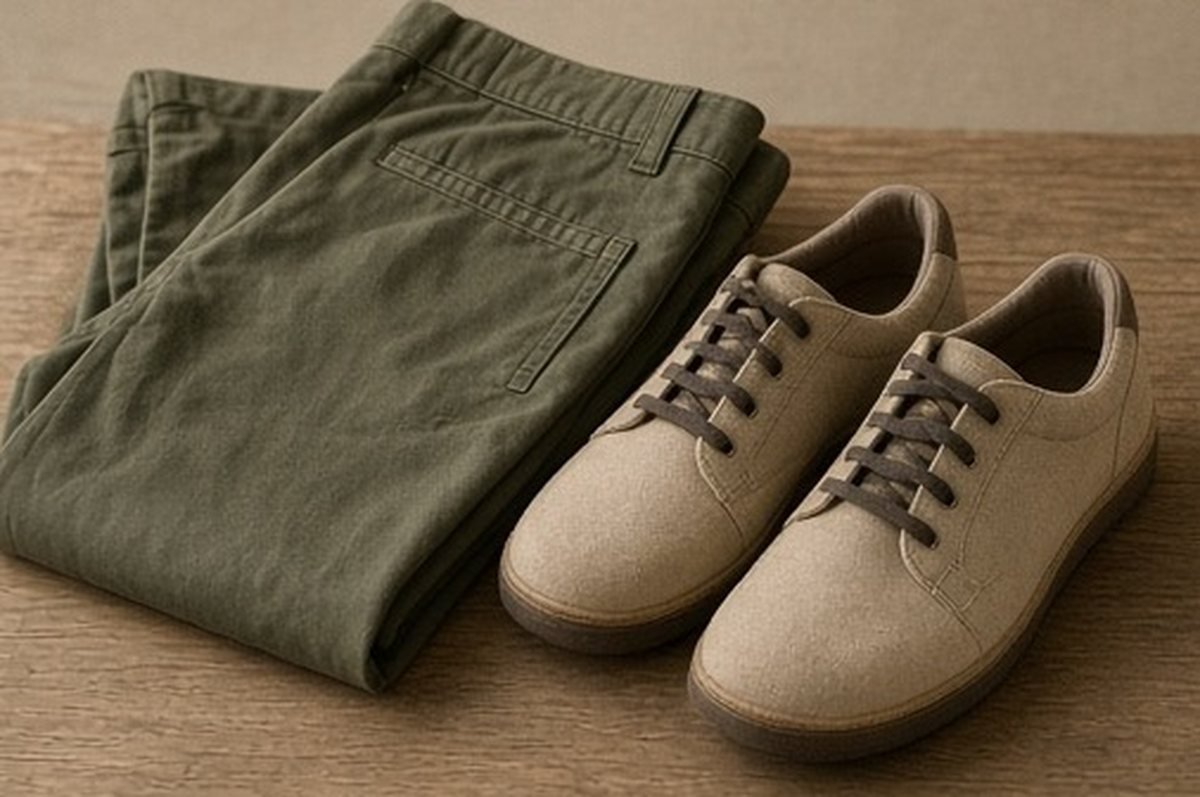
More pockets do not automatically mean less luggage or a more practical pair of trousers. A pocket has to suit the object, remain accessible and feel comfortable when you move. For travel, the useful comparison begins with what you intend to carry rather than the number of visible panels in a product photograph.
Per the brand, Foehn lists Brise Schoeller Chino Pant and Brise Schoeller Cargo Pant styles. Those names identify different options to investigate; they do not establish pocket dimensions, security or comfort. The approach below is a way to compare requirements with verified product details, not a hands-on assessment of either style.
Empty the everyday carry first
Put the objects you normally carry on a table: phone, keys, wallet, transit pass and anything else that genuinely travels in your pockets. Remove things you carry only because they accumulated there. A trouser comparison should not begin by designing storage around receipts and unused extras you could leave at home.
Separate essentials from items that could comfortably go in a bag. Consider how frequently each object is needed and whether it must be retrieved while seated. This gives you a working inventory. It may reveal that you need one accessible pocket rather than several large ones, or that trousers are the wrong place for a bulky object.
Ask for dimensions, not appearances
Check the exact product page for pocket descriptions, photographs and measurements. If a critical dimension is absent, ask a clear question about the usable opening and depth. A large-looking panel may not correspond to a large opening, and a cargo-style name does not tell you which devices or wallets will fit.
Measure your actual objects, including cases or covers. A phone that barely enters a pocket may be difficult to retrieve or uncomfortable when sitting. Allow for ordinary handling rather than seeking a theoretical maximum capacity. Do not assume the pocket arrangement on one Foehn style also applies to another.
Distinguish closure from security
Establish how each relevant pocket closes, if it closes at all. A flap, button or zip may affect access, but no ordinary pocket arrangement should be treated as a guarantee against loss or theft. Choose storage for important documents according to the journey and your own security needs, not a reassuring silhouette.
Think about the trade-off between frequent access and containment. A transit pass needed several times in a short transfer has a different job from a backup item. Avoid placing everything in one location solely because the pocket appears generous. The comparison should reflect a sensible carrying plan rather than a capacity contest.
Test the seated position
During a permitted indoor fitting, use safe, clean objects that represent your ordinary carry. Sit naturally, stand again and notice whether contents press into the thigh or hip. Follow the retailer's return conditions and avoid marking fabric, straining seams or loading pockets heavily while you are still deciding.
The object matters as much as the trouser cut. A rigid wallet and a soft folded cloth can behave differently in similar space. If a pocket only feels comfortable when empty, decide whether you are happy to use it that way. An unused pocket is not a failure, but it should not earn imaginary practical value.
Include reaching and walking
Check whether you can retrieve a frequently used item without an awkward change of posture. Walk normally and notice movement or distraction from the contents. Avoid treating this as a performance test or repeating vigorous movements that could damage a garment you do not yet intend to keep.
Consider layers over the trousers too. A longer coat or overshirt may cover the opening you expect to use. A bag strap may sit across the same area. The complete outfit determines access, so bring those existing pieces into the comparison before concluding that a pocket arrangement will simplify the day.
Leave room for the fabric to work
A pocket filled to its maximum can change the way a garment hangs. Look at the waistband, side seams and hem with realistic contents, not only with the trousers empty. If carrying your usual items creates unwanted pulling or an uncomfortable shift in balance, a different storage arrangement may be more useful than a larger size.
Do not infer fabric composition, abrasion resistance or weather protection from the trade name alone. Read the specifications for the exact style. The pocket plan is only one part of choosing trousers; fit, care and suitability for the activities remain separate decisions that need their own evidence.
Make laundry part of the routine
Whichever style you choose, develop a reliable pocket-emptying check before cleaning. Small objects and paper can cause avoidable trouble if forgotten. Follow the garment's label for cleaning and fastening instructions instead of assuming all travel trousers use the same process.
A pocket inventory can help here too. Knowing where you usually keep keys and cards makes it easier to check deliberately rather than patting the garment at random. If there are several compartments, learn their locations. More storage is only convenient when it remains understandable after a long day and before a hurried laundry stop.
Compare the whole carrying system
Summarise the decision with the objects you need, the verified pocket details and any unanswered questions. Then compare the trouser-and-bag combination, not the trousers in isolation. A simpler style with a bag you already like may be more comfortable than loading every available compartment.
Choose cargo details if they earn their place in your actual routine; choose a chino style if that better meets the brief. You can also defer the purchase if the necessary details are missing. A useful travel wardrobe is built around comfortable, repeatable actions, not the largest possible number of places to put things.